Frequently Asked Questions
All About Pastel de Nata
(and more)
What is the recipe for Pastel de Nata? What makes it taste best? How many can we eat in one sitting? Why am I hearing bells? These are some of the questions that go through the minds of those who visit us.
As we don’t like to leave anyone hungry, we will satisfy your curiosity and answer the most frequently asked questions from our customers.
About
Pastel de nata
What is Pastel de Nata?
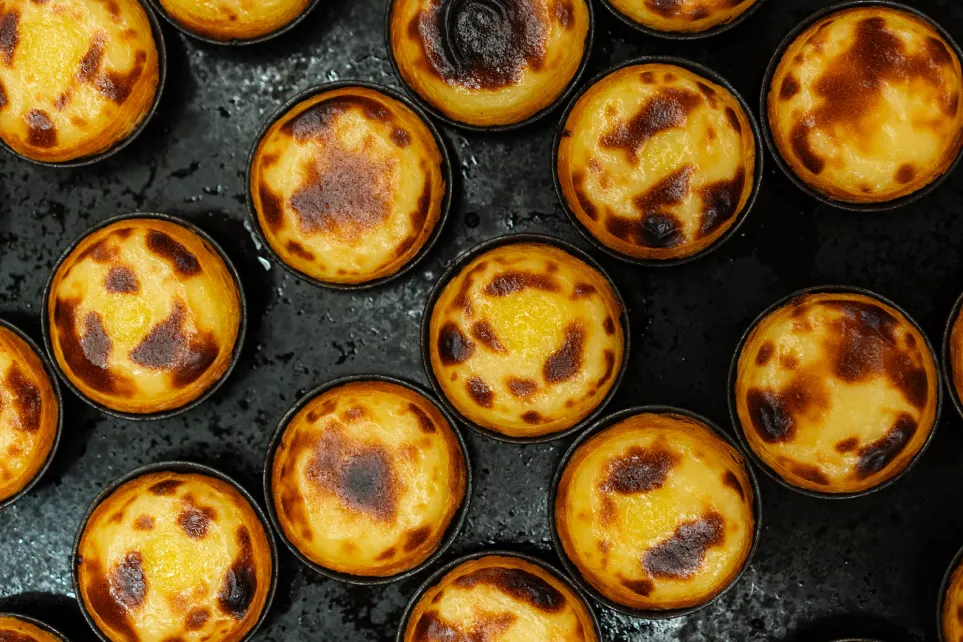
Pastel de Nata is one of the most iconic sweets in Portuguese confectionery. It is a small cake of crispy puff pastry, filled with a velvety cream. It is a classic and elegant sweet that transcends generations and borders, with many fans around the world. Despite the name, the pastry does not contain cream. You only find out by tasting it.
What is the origin of Pastel de Nata?
Pastel de Nata is the most popular specialty of Portuguese confectionery. The first records date back to the 16th century, in the recipe book of Infanta D. Maria of Portugal (1538 – 1577), “Manual de Cozinha da Infanta D. Maria”, then known as “Pastéis de Leite”.
Does Manteigaria's pastel de nata have secret ingredients?
Not at all. The pastel de nata is made with flour, butter, margarine, eggs, milk, water, sugar, cornstarch, cinnamon stick and lemon juice. These are simple ingredients; the “secret” lies in how we mix them and what we feel while doing it.
How is Manteigaria's pastel de nata made?
The process has four essential steps:
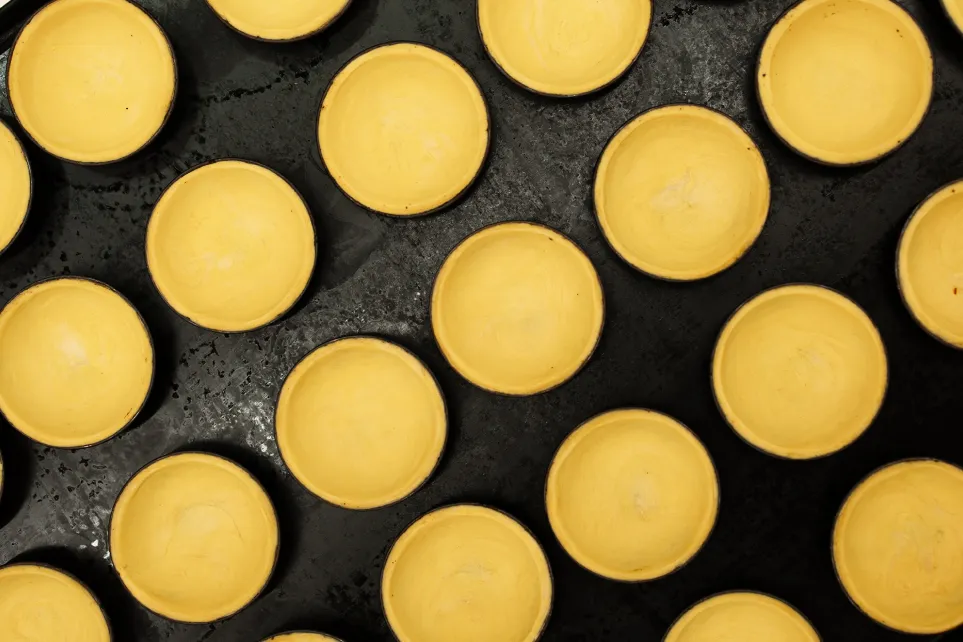
- Puff pastry – It is stretched, rolled, and shaped by hand into forms that give it its traditional shape.
- Cream – Made with care and patience, it’s cooked to the perfect point to become velvety.
- Assembly – Each mold receives the ideal amount of batter and cream, in an exercise of skill and precision.
- Oven –
- This is where the magic happens, and the pastel de nata takes on its golden color and texture. It always comes out perfectly cooked, so that the pastel de nata is crispy on the outside and creamy on the inside when it reaches your hand.
All this happens right in front of you, in every Manteigaria factory. Order a Pastel de Nata and watch us prepare the next batch.
What is the recipe for Pastel de Nata?
If you want to exercise your culinary skills and make a batch of Pastéis de Nata at home, we have an easy-to-follow recipe. Just click on the link eand follow the instructions.
How do you eat
a Pastel de Nata
How do you eat a Pastel de Nata?
There are no rules. Some people eat it all at once, some prefer to sprinkle cinnamon and/or sugar on it, some eat it straight from the oven (we recommend you be careful not to burn your tongue, so you can enjoy more Pastéis de Nata later), and some use a spoon to savor it slowly. Experiment and discover your way. The important thing is that you enjoy the Pastel de Nata.
How many Pastéis de Nata can I eat at once?
One or two is the most common serving: the first to discover, the second to confirm. Emma Stone ate 60 and won an Oscar. But eating Pastéis de Nata is a pleasure, not a record to beat. Eat as many as you want, as long as you like.
What drink goes best with Pastéis de Nata?
Coffee – the famous bica, the national espresso – is the classic choice. But a glass of Port wine or a ginjinha are also good options. Pastéis de Nata has the superpower of going well with everything. Especially with you.
Is Pastéis de Nata eaten on any special occasion?
All occasions are good for eating a Pastéis de Nata. For breakfast, as a snack, during a work break, or for dessert after dinner. If you’re enjoying it alone, spectacular. If you’re in the right company, even better. For Pastéis de Nata, any special occasion.
Storing and Transporting
How to store Pastéis de Nata?
If, by some miracle, there are any leftovers, the Pastéis de Nata should be kept out of the box and placed on a plate in a cool, dry place. Avoid storing it in the refrigerator – the pastry loses its crispness. Experience shows that Manteigaria’s Pastel de Nata stays crisp and flavorful even the next day if you follow this recommendation. Experience also shows that Pastel de Nata tend to disappear overnight.
Can I reheat the Pastel de Nata?
Oven: 180ºC for 2 to 3 minutes.
Microwave: Not recommended – the custard heats up, but the pastry loses its consistency.
Is it possible to freeze Pastel de Nata?
Pastel de Nata:
Nutricional
Information and Allergies
Is Manteigaria's Pastel de Nata vegetarian/vegan?
No. Pastel de Nata contains milk, butter, and eggs.
I have allergies. Can I eat Manteigaria's Pastel de Nata?
Pastel de Nata contains gluten, eggs, milk, and cinnamon. It may also contain traces of soy.

Is Pastel de Nata healthy? How many calories does Pastel de Nata have?
Compared to other Portuguese pastries, it has less fat and fewer calories. One Pastel de Nata has about 200 kcal, which can be easily burned off with a walk of just under an hour or 50 minutes of dancing.
For example, if you walk the route of all the Manteigarias in Lisbon, you can eat a Pastel de Nata at each one, and still have one or two more. Above all, it’s a treat that even the most fitness-conscious can enjoy.
Coffe and
Pastel de Nata
What coffee do they serve at Manteigaria?
The coffee at Manteigaria is Delta Platinum Professional Coffee, a flavorful blend of beans originating from Asia and Central America, perfect to accompany a freshly baked Pastel de Nata.
What coffee-based drinks do they have?
You can order espresso (bica), double espresso, abatanado, galão, cappuccino or meia de leite.
Can I order coffee to take away?
Of course. All drinks are available for takeaway. Don’t forget to put them in the blue recycling bin afterwards
What goes best with Manteigaria coffee?
Pastel de Nata. But you already knew that 😉
Manteigaria
Experience:
Shops and Rituals
Where can I eat Manteigaria's Pastel de Nata?
Manteigaria has factories in Lisbon, Porto, Braga, Paris, Madrid and Macau. Find the nearest one here. If there isn’t a Manteigaria in your city yet, don’t despair. We are always opening new factories.
Are the Pastel de Nata made in the shop?
They are made to order! In all factories, Pastel de Nata are prepared in the right quantities to be enjoyed fresh every time. We are the only ones who show the entire production process from start to finish. What you see is what you eat.
Do I need a reservation?
No. Show up whenever you want. There’s always a fresh batch ready to come out. Bring a friend. Bring lots of friends. There are Pastéis de Nata for everyone.
What does the bell mean?
Whenever you hear the bell ringing at the door of a Manteigaria, it means another delicious batch of Pastéis de Nata has come out. But there’s no rush, more will be coming soon.
How to order
Pastéis de Nata
Do you accept orders for Pastéis de Nata?
Yes, we accept orders, small and large.
What is the minimum/maximum number of Pastéis de Nata I can order?
We don’t have minimum order quantities. If it’s a few, we always have a batch coming out. If it’s a lot, we have many batches. It’s best to talk to us if you have any questions.
Are Pastéis de Nata made to order?
No, we always have fresh batches coming out. Our Pastéis de Nata are always fresh, from the day, ready to pack, ready to take away, ready to eat. How many are there?
How far in advance should I place my order?
For orders via email, we recommend up to 1 business day in advance; for orders via telephone, it can be immediately.
How can I pay for my order?
The payment methods we accept are:
- Cash or ATM/ATM payment in store.
- Payment by bank transfer is only available for orders of 50 units or more.
How can I order your Pastéis de Nata?
You can email info@manteigaria.com or call any of our factories
Still have questions
about Pastéis de Nata?
Didn’t see your question here? Send an email to info@manteigaria.com and ask us your question. Or visit a factory and speak directly to our team. While you wait for our reply, try a Pastéis de Nata.